How to Create an Airbnb Welcome Book Guests Actually Use
The complete guide to creating an Airbnb welcome book guests genuinely use: what to include, how to structure it, digital vs printed, and how to keep it current.
 By Emily Parker7 min read
Every experienced host eventually learns the same lesson: the difference between a good stay and a great one is rarely the property — it's whether guests could find answers the moment they needed them. The Airbnb welcome book is where those answers live. Done well, it's the quiet workhorse of hospitality: fewer messages in your inbox, smoother arrivals, better dinners, warmer reviews. Done badly — or not at all — every gap becomes a question, and every question becomes your problem at 9pm.
This is the complete guide to creating a welcome book guests actually use: what goes in, how to structure it, how to choose between printed and digital, and the maintenance habit that keeps it trustworthy for years.
What an Airbnb welcome book is (and what it's for)
A welcome book — also called a guest book, house manual or guidebook — is the single organised home for everything a guest needs during a stay: arrival and access details, Wi-Fi, how the house works, house rules, local recommendations and checkout instructions. Traditionally it was a binder on the coffee table; increasingly it's a digital guide guests open on their phones from a link or QR code.
Its purpose is sharper than "being helpful". A welcome book exists to answer questions at the moment they occur — which is standing at the door with luggage, holding a phone at the supermarket, or packing at 9am on checkout day. That framing drives every good decision about the book: what to include, how to organise it, and which format to choose. A book that guests consult beats a book that guests admire; usage is the only metric that matters.
The seven sections every welcome book needs
Structure the book around the stay itself, in the order guests experience it:
1. A short welcome. Two or three warm sentences — who you are, that you're glad they're here, how to reach you. Resist the essay; the introduction has its own craft.
2. Arrival and access. Address, parking, entrance steps with photos, keys or codes. This section works hardest and fails most expensively, so build it for a tired traveller in the dark, step by step, with a photo at every decision point.
3. Wi-Fi, front and centre. Network and password, formatted for copy-paste (or better, a tap-to-copy widget). It's the most-consulted page in every welcome book ever made.
4. How the house works. Heating, hot water, TV, appliances, quirks — each with a photo where showing beats telling. This is the house manual layer, and it's what separates a complete book from a decorative one.
5. House rules, warmly stated. The handful that matter, each with its reason — "quiet after 10pm; the walls are old and the neighbours are lovely" outperforms a list of prohibitions.
6. Local recommendations. Your genuine favourites — restaurants, coffee, walks, rainy-day options — with enough detail to act on. This is the section guests remember in reviews.
7. Checkout. Time, keys, the two or three tasks that genuinely matter. Short and unmissable.
Even half-filled, these seven sections already outperform most listings' current setup.
Designing for the moment of need
Here's where most welcome books quietly fail: they're written to be read cover-to-cover, and no guest has ever done that. Guests consult — they arrive with one question and want one answer. Designing for consultation means:
Order by stay chronology, so the book's structure matches the guest's mental model: arriving → settling → living → exploring → leaving.
Make every section skimmable. Headings that name the question ("Where do I park?"), short paragraphs, photos doing the heavy lifting. If a section needs study, it needs editing.
Surface the top three. Wi-Fi, arrival, checkout account for the majority of consultations. They should be findable in seconds from wherever the guest starts — first pages in print, home-screen widgets or search in digital.
Write like you talk. "The hot tap runs cold for ten seconds — give it a moment" beats formal manual-speak everywhere it appears. Personality is not unprofessional; it's why guests keep reading.
Printed, digital, or both?
The binder has charm; the phone has presence. The honest comparison comes down to three questions: When is it available? Printed books help only inside the property — but "how do I get in?" and "where should we eat?" happen outside it. Digital guides travel in the guest's pocket from the booking confirmation onward. How current is it? Paper is accurate as of its last printing; a digital guide is accurate as of your last edit, with no reprinting. How discoverable is it? Binders depend on guests noticing them; a link in your messages and a QR code by the door reach everyone.
Most hosts land on digital-first with a printed touchpoint: a WelcomeFlo guide as the real book — searchable, always current, with live local listings and tap-to-copy Wi-Fi — plus a framed QR code where the binder used to sit. You get the physical presence without the physical maintenance.
Building yours: the realistic afternoon
The blank page is the enemy, so don't start from one. Start from a template — WelcomeFlo's guides open with the seven-section structure pre-built — or, if you already have a listing description or an existing PDF guide, let Flo Importer draft the sections from that instead. Then work through three passes:
Pass one, the brain dump (40 minutes). Fill each section with what you'd tell a friend staying for the weekend. Don't polish; the goal is coverage. Your saved message replies are a goldmine here — anything you've typed twice belongs in the book.
Pass two, the photos (30 minutes). Walk the property phone-in-hand: the entrance approach, the lockbox, the thermostat, the bin store, the quirky window latch. One photo per how-to; they'll prevent more questions than any paragraph.
Pass three, the guest test (20 minutes). Open the book as your last guest: can you find the Wi-Fi in ten seconds? Follow the arrival steps literally? Answer "where's dinner?" with confidence? Fix what stalls you, then publish and put the link in your booking messages.
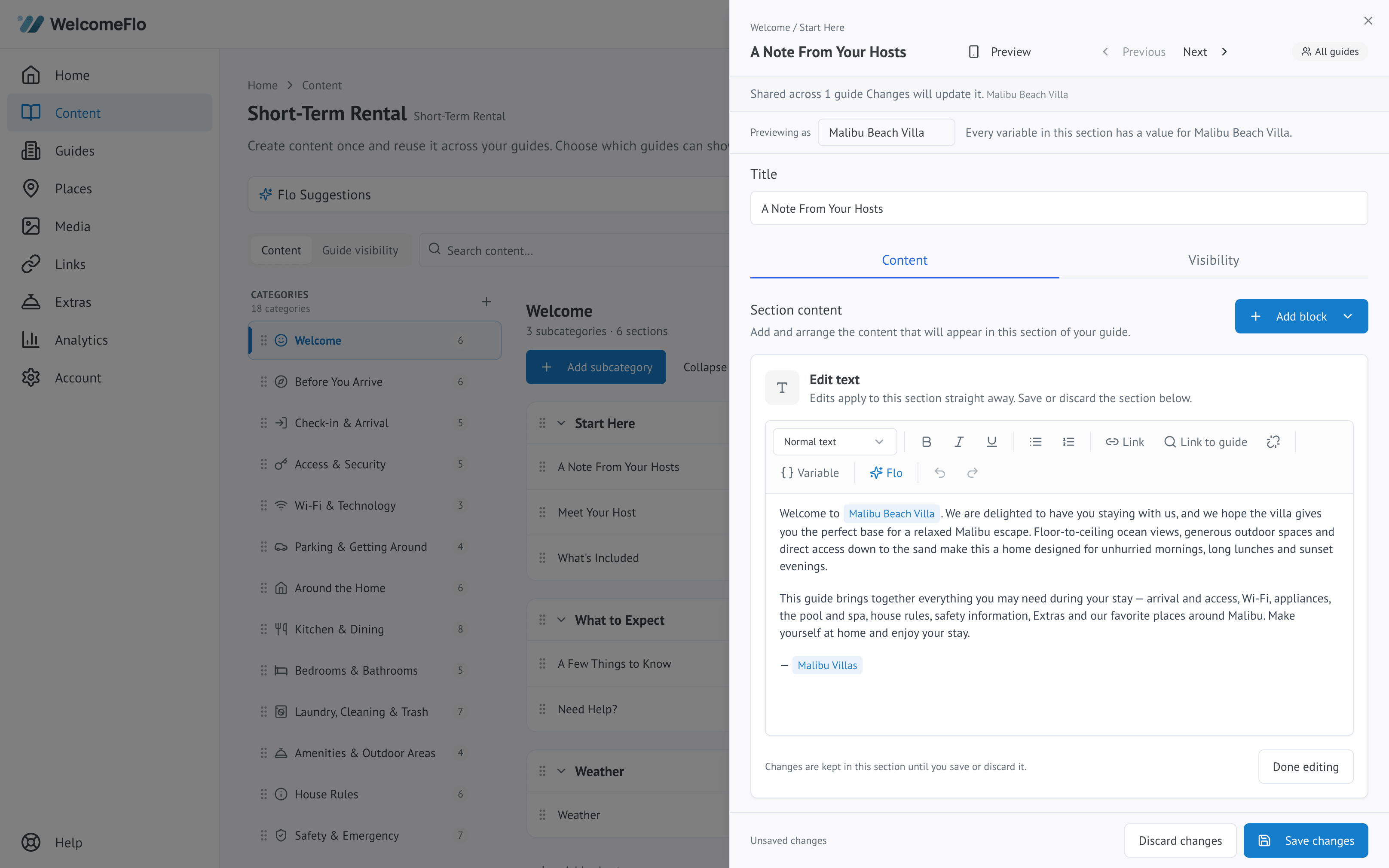
That's genuinely it — an afternoon to build, and each future improvement takes minutes because the structure is sound.
Keeping it alive
A welcome book is a living document, and staleness is its only real enemy — the closed restaurant still recommended, the changed code still printed. Two habits keep it trustworthy: promote every repeat question (anything asked twice becomes book content the same day), and let the platform maintain what it can — in a digital guide, recommendations backed by live Google data keep their own photos and opening hours current, and one edit updates every copy instantly. Multi-property hosts get the compounding version with WelcomeFlo's Content Library: shared sections exist once across every property's book, edited once, current everywhere.
What a great welcome book does for reviews
The welcome book's return on investment shows up most visibly in your reviews, through three mechanisms worth understanding.
It removes the friction reviews punish. Read one-star-off reviews across any market and the same phrases recur: "hard to find", "couldn't work the heating", "had to keep messaging the host". Each is a welcome book gap wearing a rating. Closing the gaps doesn't just prevent complaints — it removes the asterisks from otherwise five-star stays.
It creates the moments reviews celebrate. "The guide's restaurant tips made our trip", "check-in was the smoothest we've had", "everything was thought of" — these sentences come from books that worked. Guests rarely praise the absence of problems, but they reliably praise the presence of care, and a thorough, personal welcome book is care made visible.
It signals professionalism that colours everything else. A guest who opens a polished guide in the first hour extends that impression to the whole property — the same psychology that makes hotels put effort into lobbies. First impressions are cheap to engineer and expensive to repair; the welcome book is the first impression you control completely.
Hosts who track their review language before and after a proper book consistently report the shift: fewer logistics complaints, more "so easy" and "thought of everything". That's the book working.
The bottom line
A great welcome book is chronological, skimmable, photographed, warm and current — and it repays its afternoon of creation for years, one prevented question at a time. Start with the structure, fill it with what you already know, and fix the gaps real guest questions reveal. Build it as a free WelcomeFlo guide and your inbox will report the results within a fortnight.
Create your digital welcome book
Build a beautiful mobile guest guide with WelcomeFlo.