AI for Vacation Rentals: What Hosts Can Automate Today
A realistic map of AI for vacation rentals: what hosts can automate today across writing, operations and analysis, what's overhyped, and how to adopt it safely.
 By Daniel Foster7 min read
Somewhere between "AI will run your vacation rental" and "it's all hype" sits the question working hosts actually need answered: what, specifically, can I hand to AI this month — and what happens if I do? The honest answer divides hosting's AI surface into three zones: writing work AI accelerates dramatically today, operational work where AI assists inside guardrails, and a frontier of promises worth watching but not yet trusting with guests.
This article maps all three zones for the vacation rental world specifically — the wins, the assisted middle, the overhyped edge — and closes with the adoption sequence that captures the value without the face-plants.
Zone 1 — The writing wins: adopt today
Vacation rental hosting is a writing-heavy business in disguise — messages, listings, guides, responses, policies — and writing is where current AI is unambiguously strong. Four uses with immediate payback:
Message drafting. The delicate declines, novel situations and awkward review responses that used to cost ten composition minutes each now cost ninety seconds of prompt-and-edit — the full workflow (prompt pattern, voice bank, editing pass) makes drafts sound like you and stay factual.
Listing copy at variation speed. Headlines A/B'd, descriptions re-angled per season or audience, amenity lists turned into prose — AI assembles fluently from the true details you supply. Your final honesty pass stays mandatory; AI gilds by default.
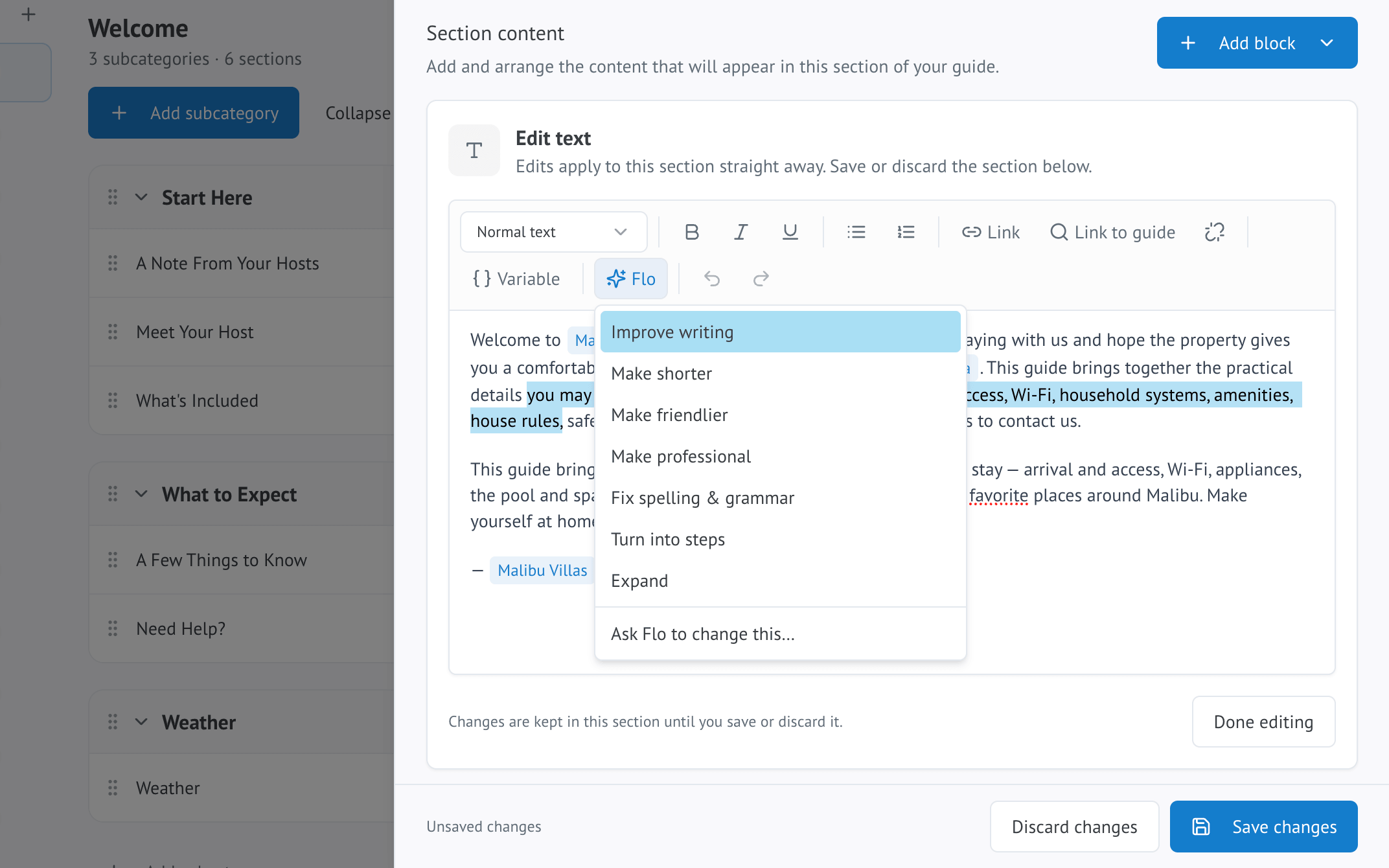
Guide and template scaffolding. First drafts of guide sections, house rules with reasons, message template sets — the shape arrives in seconds, then every fact gets replaced with your property's truth. WelcomeFlo's Flo Assistant does this inline while you're editing a guide — improve, shorten, make friendlier, turn into steps — plus a version that imports directly from a PDF or an existing listing rather than starting from a blank section. The welcome book build stays a real session; the blank-page portion of it disappears.
Translation and register shifts. Key messages rendered for international guests; the same content re-registered formal, warm or playful on demand — the everyday language gap, closed.
The common thread: in every case a human reviews before anything reaches a guest. That single rule is what makes Zone 1 safe at current model reliability — the risk map explains the failure modes (confident invention chief among them) that make review non-negotiable.
Zone 2 — Assisted operations: adopt with guardrails
Beyond writing, AI usefully assists — rather than runs — several operational surfaces:
Review and feedback analysis. Paste a year of reviews, get the recurring themes ranked — the reviews-dip audit accelerated from an evening to minutes. Same for guest message history: "what questions arrived most last quarter?" feeds the question-reduction loop with data instead of impressions.
Pricing sanity checks. Dedicated dynamic-pricing tools (statistical, not generative) remain the right instrument for nightly rates; general AI's useful role is the reasoning layer — "here's my occupancy pattern and local events; critique my seasonal rate card" — a thinking partner, not a rate-setter.
Operations documents. Turning your voice-notes into clean cleaning checklists, cleaner briefings translated for a multilingual team, the maintenance log summarised into a tradesperson work order. Low-stakes, genuinely time-saving, and errors are visible to you before they cost anything.
Photo triage at scale. Multi-property operators use image-capable AI to sort turnover checkpoint photos ("flag any room that doesn't match the staging reference") — assistance for the human eye, not replacement, but real minutes at portfolio scale.
The Zone 2 rule: AI advises, systems and humans decide. Nothing here sends, prices, or approves autonomously.
Zone 3 — The frontier: watch, don't lean
Three promises dominate AI-for-rentals marketing and deserve dated scepticism. Autonomous guest messaging — AI answering guests directly without review — remains blocked by the invention problem: one confidently wrong answer per hundred is catastrophic in hospitality, and current models haven't cleared that bar; the practical version that does work today is self-service information done well — a searchable guide answers most questions instantly with zero invention risk, which is most of what "AI concierge" pitches actually promise. Fully automated guest screening — beyond platform verification, AI-scored guests drift toward bias and discrimination exposure; keep decisions human. "Set and forget" AI property management — the pitch that dissolves the supervisory habits; no current system replaces the weekly human glance, and vendors claiming otherwise are selling the gap between demo and season.
Frontier movement is real — fact-bounded assistants that answer only from your verified content are the credible next step, and tools like WelcomeFlo's Ask Flo already work this way: it answers a guest's question from the guide's own content rather than inventing one, and says so when it doesn't know. Notice the interface choice too, because it's part of the safety story: Ask Flo lives inside the Search tab a guest already uses for ordinary keyword search, rather than presenting itself as a separate chat window — which keeps it feeling like a smarter version of the guide's own search rather than a bolted-on demo, and every answer links back to the guide section it drew from, so a guest can verify the source in one tap. That's a meaningfully different risk profile from a general chatbot improvising an answer, but it's still worth verifying against your own guide before you rely on it for anything safety-critical.
The adoption sequence: value first, novelty last
The pattern that works mirrors automation adoption generally: foundations before flourishes. First, the non-AI automation layer — scheduled messages, the guide, checklists — because it removes more workload than any current AI and provides the verified content later AI uses safely. Second, Zone 1 writing wins — voice bank built, editing pass habitual; a week of practice. Third, Zone 2 analysis — quarterly, feeding the audits you already run. Last and optional, dedicated AI host products — evaluated with the standard tools questions: what specific pain, what threshold, and does it respect your canonical information source or want to replace it? Hosts who run this sequence report the same shape of result: AI saves real hours in the writing layer, sharpens the analysis layer, and changes nothing about what makes the property review well — which was never the typing.
A week with AI in the loop: what it actually looks like
The abstract zones become clearer as a diary. Monday: a guest asks whether the cottage suits a wheelchair-using grandmother — a delicate, specific question. The host voice-notes the honest facts (two entrance steps, ground-floor bedroom, bathroom door widths), AI structures them into a warm, precise reply, the host checks every measurement and sends. Nine minutes becomes three, and the message is better organised than either would have managed alone. Wednesday: the quarterly review analysis — forty reviews pasted, themes requested. Two surprises surface: three separate mentions of the bedroom being warm in summer (a fan purchase and a guide note result), and repeated praise for a walk the listing never mentions (it's in the listing copy by Thursday). Friday: a German-speaking guest's arrival — the check-in essentials translated, short sentences surviving the round trip intact. Sunday close: the week's one novel situation (a guest asking to ship a package ahead) becomes a new quick-reply template, AI-drafted from the reply that worked, filed for the next time.
Nothing in the week was autonomous; everything was faster. That's the current state of the art, accurately sized — AI as the sharpest assistant hosting has had, working entirely inside the host's judgement.
What to tell guests (if anything)
Hosts sometimes ask whether AI use needs disclosing. For drafting assistance — the uses in this guide — no more than spellcheck does: the message is yours, reviewed and sent by you, and its accuracy is your warranty either way. The disclosure question only becomes real at the frontier you're avoiding anyway: a bot conversing with guests as if human crosses into deception regardless of how well it performs. The working rule: AI behind you, fine; AI pretending to be you, never — which is one more reason the review-before-send habit is the entire ethics policy a small host needs.
The bottom line
Three zones: writing wins to adopt today (with review), assisted operations to adopt with guardrails, and a frontier to watch with dated scepticism. Sequence foundations first — the free guide and scheduled messages remain the highest-value automation in hosting, AI or not. WelcomeFlo's Free plan gets that foundation built; Flo Assistant is there on Pro when you're ready to add the Zone 1 drafting speed to it. Take the drafting speed, keep the human judgement, and let the frontier prove itself on someone else's reviews.
Create your digital welcome book
Build a beautiful mobile guest guide with WelcomeFlo.